


“…a history of repeated injuries and usurpations…”
A list of King George III’s supposed crimes against the American colonists fills most of the Declaration of Independence. Yet almost nobody reads that part of the famous document.
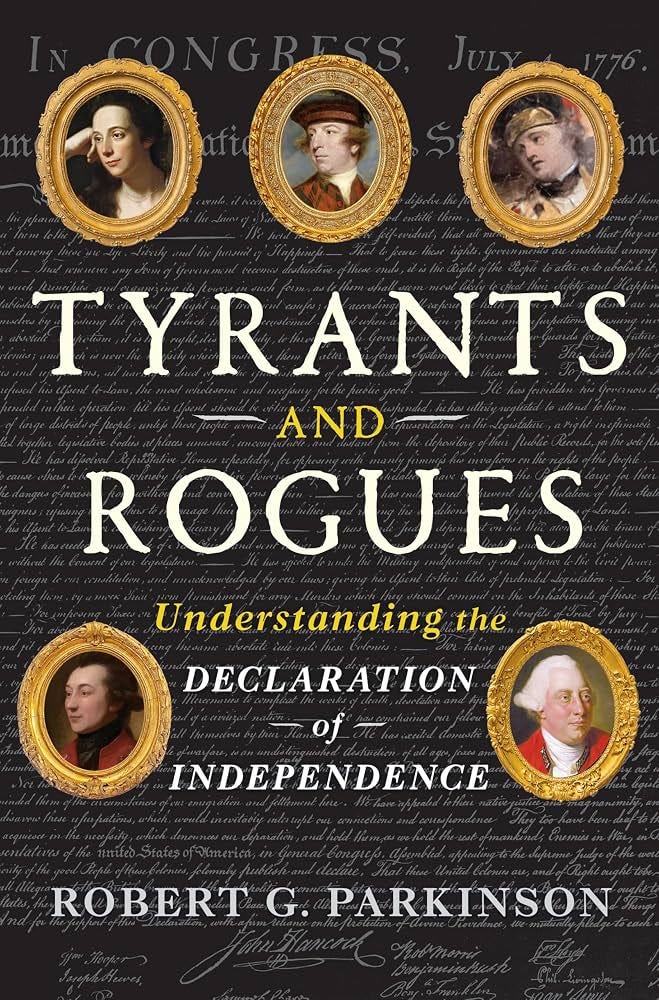
Robert G. Parkinson is a historian at Binghamton University and the author of Tyrants and Rogues: Understanding the Declaration of Independence. Parkinson argues that the Declaration’s long grievances section—the colonists’ bill of complaints against the Crown—opens a useful window onto the real world of 1776, one that we miss if we focus on the preamble’s celebrated phraseology.
In this episode of THINK BACK, Parkinson and I discuss how conspiratorial thinking shaped the patriots’ case for revolt; the military occupation of Boston and the propaganda campaign waged against it; and the deleted final grievance on slavery (including Parkinson’s discovery of long-missed marks on Jefferson’s draft that reveal just how contested that passage was, and how much issues around race played into what became the final text).
The themes embedded in the grievances—race, violence, exclusion, the weaponization of the language of liberty—are still very much with us as the nation the Declaration created marks the 250th anniversary of its founding.
See also my essay for The Nation’s special 250th issue: “Our Revolution”
Music for this episode: “The Union,” by Louis Moreau Gottschalk, performed by Akiko Sasaki; “Reel Delisle,” by Joel Zifkin; interlude by Zachary Solomon
Looking for more on the American Revolution? See these previous episodes of THINK BACK.
The Unfinished Business of 1776

In this episode of Think Back, I speak with historian Thomas Richards Jr. about his new book The Unfinished Business of 1776: Why the American Revolution Never Ended. Richards opens with a deliberately provocative contrast: was the Revolution an inspirational fight for freedom, or a vicious struggle for power? His answer sets up a book that refuses easy…
'America Among, Not America Alone'

In this episode of Think Back, I talk with historian Richard Bell about his fascinating new book The American Revolution and the Fate of the World—a work that completely rethinks the Revolution as a global story, not just an American one.
The Hidden Origins of the American Revolution

The 250th anniversary celebration of the American Revolution is about to get underway in Lexington and Concord, the towns just outside Boston where British redcoats first clashed with colonial rebels. But just a day later and hundreds of miles south, a more complicated and perhaps more consequential clash occurred between the royal governor of Virginia …


