


Has the Civil War’s single largest emancipation event been hiding in plain sight?
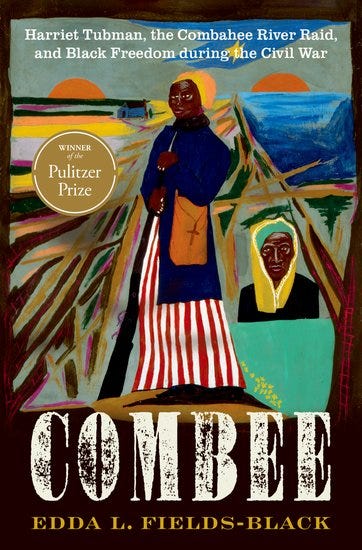
In this episode of Think Back, I speak with historian Edda L. Fields-Black about her book Combee: Harriet Tubman, the Combahee River Raid, and Black Freedom During the Civil War (2024), co-winner of the Pulitzer Prize in History. The book reconstructs a remarkable and underexamined chapter of the war: a Union gunboat raid up South Carolina’s Combahee River, led in part by Harriet Tubman acting as scout and spy, that liberated more than 700 enslaved people in a single night.
We discuss how the Lowcountry’s geography shaped both the institution of slavery and the possibilities for resistance, what it meant for some of the first Black soldiers in the Union Army to return in uniform to the communities they had escaped, and how Tubman’s role in the raid fits into the larger arc of her extraordinary life. We also talk about the craft behind this kind of history, how Fields-Black uses mountains of primary sources to reconstruct not just events but an entire world, and what it means to her personally to tell the story of an ancestor who was on one of those gunboats with Tubman the night of the raid.
Fields-Black brings formidable scholarly rigor to this story without ever losing her enthusiasm for it. The people she writes about are deeply alive for her, 160 years on, and she helps make them feel alive for us as well. I think you’ll really enjoy this conversation.
Music for this episode: “The Union,” by Louis Moreau Gottschalk, performed by Akiko Sasaki; “Reel Delisle,” by Joel Zifkin; interlude by Zachary Solomon
Looking for more on the American West? See these previous episodes of THINK BACK.
What Really Happened on Sherman’s March?

In the fall of 1864, General William Tecumseh Sherman led his infamous “March to the Sea,” a military campaign long mythologized—especially in Gone With the Wind—as a brutal assault on the white South. But over the past several decades, historians have chipped away at that Lost Cause narrative, revealing it as a distortion that casts Confederates as vic…
How Slavery Ended

In this episode of Think Back, I talk with historian Tom Zoellner about his new book The Road Was Full of Thorns: Running Toward Freedom in the American Civil War. We dig into a dimension of emancipation that often gets overshadowed by presidential proclamations and congressional acts: the ground-level pressure created by enslaved people themselves. Zo…
The Unfinished Revolution of 1963

I’ve always had a soft spot for what you might call “year books”—not the high school kind, but those immersive histories that zoom in on a single calendar year to show how change unfolds in real time. Some years lend themselves especially well to this treatment, and 1963 is one of them: the year of Birmingham and the March on Washington, of Dr. King’s “…


